{{ noteMeta }}
{{ note.title }}
{{ note.dek }}
{{ p.text }}
Research note, not legal or investment advice. Confirm any structure with independent Thai counsel. ← All insights
A right registered at the Land Office, in your own name.
Three answers. Your track, tier and first step.
Own it. We run it. Trade it inside the network.
Sellable, mortgageable, inheritable. Registered in 14 days.
The legal solution →One standard, one platform, 24/7 cover.
The operational solution →Matched inside the network. Days, not months. No agent commission.
The trade solution →Four things must be true before a villa carries it.
A villa with the dot sells faster.
What you own, or plan to buy.
Pricing, income estimate, membership.
We acquire it. Your right is registered.
Listing, check-in, pricing, dashboard.
You collect income. You can trade out any time.
A real person replies within 24 hours.
One Thai-owned company owns the land. One right, in your name, on the same deed.
It follows the land, not the landlord.
Type your name as it appears in your passport.
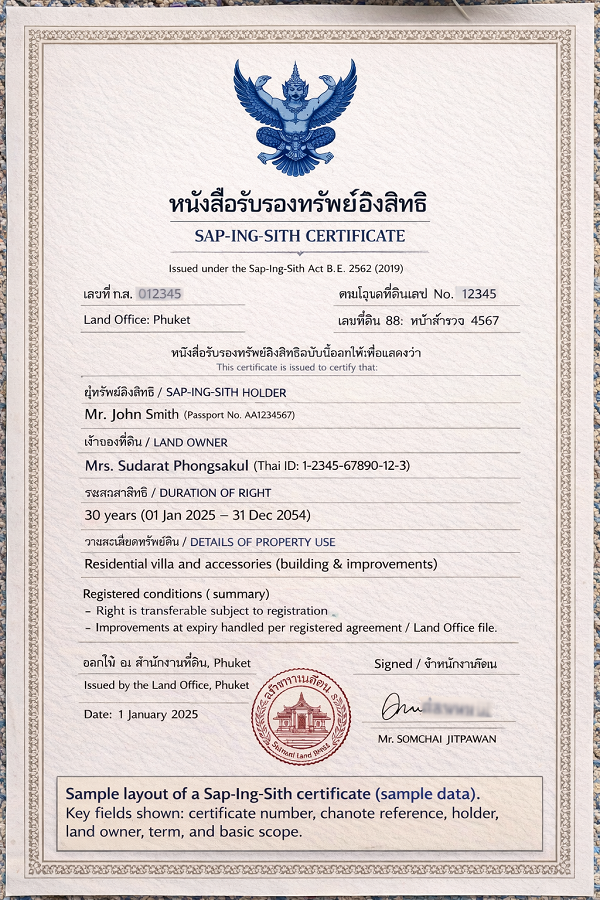
Specimen. Your certificate is issued by the Land Office.
Same registered right. Different way in.
A clean asset purchase. Your right on the same deed. Your old structure left behind.
We pay the seller, take title, register your right in your name.
Only properties that fit the portfolio.
Not legal advice. Have the documents reviewed by your own Thai counsel before signing.
A lease is a contract. Sap-Ing-Sith is a property right on the deed.
| Feature | Standard 30-yr lease | Sap-Ing-Sith |
|---|---|---|
| Legal nature | Personal contract | Registered property right |
| On the title deed | Optional annotation | Inscribed on the Chanote |
| Transferable | Needs landlord consent | Freely transferable |
| Inheritable | Usually contested | Inheritable by statute |
| Collateral | Not mortgageable | Mortgageable |
| If the owner changes | At risk | Survives — it's on the title |
Not legal advice · confirm your structure with independent Thai counsel
5% once (min ฿500,000) + 2% a year.
15% under ฿15M, 10% above. Once, at signing.
Nothing at signing. 10% a year.
Excludes Land Office fees, stamp duty and counsel. Government fees split 50/50.
Set your track and value.
{{ trackBlurb }}
Indicative. Excludes government fees and counsel. Proposal follows due diligence.
United Grace Co., Ltd. holds title. Your right is registered on that same deed, in your name.
Live in it, rent it, sell it, mortgage it, leave it to your heirs.
About 14 days. Days 1–3 commitment, 4–10 acquisition, 11–14 registration.
Title stays with us. You can sell your right inside the network at any point.
One standard behind the blue dot. You watch the dashboard and collect the income.
Multi-channel listings, priced weekly against the island.
Vetting, smart check-in, housekeeping, 24/7 concierge.
Preventive schedules, vetted trades, one contact.
Own more or refer more: lower fee, more included.
+ ฿2,000 / mo · minimum ฿20,000 / mo
+ ฿2,000 / mo · minimum ฿20,000 / unit / mo
Membership fee waived · minimum management ฿20,000 / unit / mo
Fee = the greater of the tier percentage or ฿20,000 per unit per month.
Pay extra at Silver. Included as you climb.
| What's included | Silver | Gold | Platinum |
|---|---|---|---|
| Core — always included | |||
| Management fee | 25% | 22% | 20% |
| Full management & hosting | Included | Included | Included |
| Multi-channel listing & dynamic pricing | Included | Included | Included |
| Live dashboard & monthly statements | Included | Included | Included |
| Premium — unlocks as you climb | |||
| Community membership | ฿2,000 / mo | ฿2,000 / mo | Waived |
| 24/7 concierge | +฿3,000 / mo | Included | Included |
| Priority same-day maintenance | +฿2,000 / mo | Included | Included |
| Investors' Club — buy & sell inside the network | — | Included | First right of refusal |
| Dedicated personal manager | — | — | Dedicated personal manager |
| Owner stays & network exchange | Owner rates | 3 nights / yr | 7 nights / yr + priority |
| Annual photography & re-listing | +฿6,000 / yr | +฿6,000 / yr | Included |
| Lifestyle membership & partner perks | — | — | Included |
Add-on prices confirmed in your proposal.
Every owner you introduce who closes moves you up a full tier. Permanently.
Location, bedrooms, occupancy. Estimate within 24 hours.
We own the land, run the villa and hold the numbers. Nothing left for a buyer to check.
A normal resale means weeks of checking. Here, every answer comes from us.
Your right moves to the buyer at the Land Office. No shares, no directors, no nominee history.
Every booking, expense and repair is already in our system. Full file, same day.
Gold and Platinum see every exit first — and are usually funded.
A transfer inside the network is a registration, not a negotiation. The land is already ours and stays ours. The right is already registered. The financial history is already in our system. That is why all three sides come out ahead.
No listing, no viewings, no 6–10% agent fee. The buyer is already a member and already funded.
Full audited operating history the same day, and the right registered in their own name at the Land Office. Nothing to inherit, nothing to unpick.
Our title never moves, so nothing is restructured. The villa stays on one standard and the network gains an owner.
Every villa reports into one system. Select one.
{{ selYears }} in the network.
Seven items, same day. A normal resale takes three to six weeks.
Illustrative. Government fees apply to both routes, split 50/50.
A buyer trusts the numbers on day one.
Most exits never reach the open market.
Registered in the new owner's own name.
Every villa that joins makes your exit easier.
A 100% Thai-owned company on Koh Samui and Koh Phangan. 150 owners, 30+ villas, one standard.
Our founders bought here themselves: murky ownership, patchy management, a year to sell.
So we built the company that solves all three.
Visit a member villa. Meet the team. Speak to owners.
A real person, English or Hebrew, usually the same day.
Slower than WhatsApp. Same inbox.
The deeds we register, the villas we run, the numbers owners are paid.
Both give 30 years. Only one is registered in your name.
What the Land Office will actually register.
11 min read · July 2026Gross vs net, and the costs owners forget.
10 min read · July 2026Where demand is landing, and what's already priced in.
10 min read · July 2026Policy, demand, costs, and what buyers are paying.
Members get every note first, with the numbers attached.
{{ note.dek }}
{{ p.text }}
Bookings, income, expenses and maintenance for every property you hold. This is what it looks like.
Sample data shown · members access the live portal at owners.united-grace.com
It switches on the week we take over operations.
No forms. Drop your documents. We read them, cross-check every detail, and send prepared contracts within 24 hours.
The name — or up to three joint holders — that goes on the right at the Land Office.
Four documents from the seller side. Photos or PDFs. You type nothing.
The declared price is the figure in the transfer documents and the basis for government fees. Our valuation is declared + 2%, and that drives your track pricing.
All three give the identical registered right, and you can change track later. Run the numbers first →
Your documents are with United Grace. Within 24 hours you'll receive:
Your documents stay with United Grace. Encrypted in transit, stored securely, never shared.
If you are a foreigner buying a villa in Thailand, you will be offered one of three things: a 30-year lease, a 51/49 company, or a Sap-Ing-Sith right. All three are described as "as good as owning". They are not the same, and the differences only show up when you try to sell, borrow against the property, or pass it to your children.
Under the Thai Land Code a foreign individual cannot hold freehold title to land. Everything on the market is a way of holding something against land that a Thai person or Thai company owns. So the real question is not "do I own it" — it is "what exactly do I hold, and how strong is it".
A lease (เช่า, chao) under Sections 537–571 of the Civil and Commercial Code is a personal right. It binds your landlord, and only your landlord. Leases over three years are annotated at the Land Office, but the instrument itself stays a contract. In practice that produces four soft spots:
The Sap-Ing-Sith Act B.E. 2562 (2019) — the Property-Based Right Act — created a new registrable category of property right. It is inscribed directly on the Chanote at the Land Office, next to the freehold owner, and it attaches to the land rather than to the person who granted it. It is open to any natural or legal person, Thai or foreign, for a statutory term of up to 30 years.
Because it is a real right, it behaves like an asset: freely transferable without landlord consent, inheritable by statute for the remainder of the term, mortgageable including with Thai banks, and unaffected if the land changes hands. A new owner of the land takes the land with your right on it.
| Question | 30-year lease | Sap-Ing-Sith |
|---|---|---|
| What is it legally? | Personal contract | Registered property right |
| Can I sell it? | With consent | Freely |
| Do my children inherit it? | Contested | Yes, by statute |
| Can I borrow against it? | No | Yes |
| If the landowner sells? | At risk | Right stays on the title |
A lease gives you the use of a villa. A registered right gives you an asset. The gap between those two words is the entire decision.
This is where the theory becomes money. A buyer's Thai lawyer opens the lease and finds an assignment clause requiring the landlord's written consent. So the deal now has three parties. The landlord is entitled to say no, to take weeks to answer, or to name a price for saying yes — commonly a percentage of the sale. Meanwhile the buyer is being asked to pay today's market price for a contract with, say, nineteen years left on it, no renewal they can enforce, and no bank willing to fund it.
Most of those deals do not fail dramatically. They just drift: six months on the market, two price reductions, and a sale to a cash buyer at a discount that quietly wipes out several years of rental income. The lease was never defective — it simply was not built to be sold.
Honesty helps here. For day-to-day use they are the same: you live in the villa, you rent it out, you renovate it, you pay the same utilities and the same taxes. Both are capped at 30 years — Sap-Ing-Sith is not "longer ownership". Both sit on land owned by a Thai person or company. And both cost roughly the same at the Land Office. The difference is not the holiday; it is the exit.
Registration involves a transfer fee (typically 2% of the registered value, by Thai custom split 50/50 between the parties), stamp duty of 0.5%, and a fixed Land Office fee for inscribing the right on the Chanote. These are government fees and sit outside any service fee. Registration itself normally completes in about two weeks from signing.
If you plan to use the villa for a few years and walk away, a lease is cheap and simple. If the property is meant to be an asset — something you can rent, borrow against, sell to someone else, and leave to your family — a lease gives you none of those with certainty, and a registered right gives you all four. That is the whole comparison.
It is registered practice. The Act has been in force since 2019 and Land Offices process the inscription as a standard entry on the Chanote. The realistic constraint is not the law — it is finding a landowner willing to grant the right, which is exactly what United Grace exists to be.
Not by conversion. The land has to be acquired by a landowner who will grant the right, and the right is then registered fresh in your name. In practice that means an asset purchase — which is the route we run for owners who already hold a villa through a lease or a company.
The right expires and the land remains with the owner. Two things matter in the meantime: you can sell the remaining term at any point, and the value of what you sell declines as the term shortens — which is an argument for holding it inside a network with ready buyers rather than alone.
The right is mortgageable as a matter of law, and Thai banks can register a mortgage over it. Whether a given bank lends to a given foreign borrower is a credit decision, not a legal one — but with a lease there is nothing to secure in the first place.
Control is the problem, not the reassurance. If Thai shareholders hold their shares on your behalf, the arrangement is a nominee structure and unlawful under the Land Code and the Foreign Business Act. A registered right needs no shareholders at all.
Send the deed and your current structure. Straight answer and pricing within 24 hours.
Not legal advice. Confirm any structure with independent Thai counsel. ← All insights
Short answer: yes to a condominium unit, no to land in your own name, and everything else depends on what you hold against the land. Here is what each route actually gives you on Koh Samui and Koh Phangan.
Foreigners can hold freehold title to a condo unit in a registered condominium, provided foreign ownership stays within 49% of the building's saleable area. On Samui this is a small part of the market and almost none of it is villa product, so most buyers looking for a private pool villa never find a condo that fits.
A foreigner can own a house or structure in their own name while the land underneath belongs to someone else. It works, but it splits the asset: the value of a villa is mostly the plot and the view, and a building without a secure right over its land is difficult to sell and impossible to finance.
The most common offer. A lease is a personal contract: transfer needs the landlord's consent, inheritance is contested, and no bank lends against it. Renewal clauses beyond the registered term are promises rather than rights. We compared it properly here.
A Thai limited company owns the land; the foreign buyer holds 49% of the shares and Thai shareholders hold 51%. It is still the most frequently offered structure on the islands, and it is the one that carries real legal exposure. If the Thai shareholders hold their shares on the foreigner's behalf — funded by the foreigner, with side agreements, share pledges or undated transfers — that is a nominee arrangement, prohibited under the Land Code and the Foreign Business Act. Enforcement has come in waves, and the penalties reach the land itself.
There is also a quieter cost. A company must file accounts and tax returns every year, the shareholders age and occasionally die, and any future buyer inherits the entire history — which is why company-held villas take longest to sell and attract the deepest discounts.
Since 2019 Thai law recognises a registrable property right that a foreigner can hold personally for up to 30 years, inscribed on the Chanote itself. It is transferable without consent, inheritable by statute, mortgageable, and it survives a change of landowner. This is the route United Grace uses: our 100% Thai-owned company holds freehold title, and your right sits on the same deed in your personal name.
| Route | Sell freely | Inherit | Finance | Legal exposure |
|---|---|---|---|---|
| Condo freehold | Yes | Yes | Sometimes | None |
| Building only | Hard | Yes | No | Low |
| 30-year lease | With consent | Contested | No | Low |
| 51/49 company | Share sale | Via shares | Rarely | High if nominee |
| Sap-Ing-Sith | Yes | By statute | Mortgageable | None |
Ownership is one of three problems. The other two are running the villa well enough to earn from it, and being able to get out when you want to. Inside the United Grace network those are answered by one management standard and member-to-member transfers.
It is permitted, and it is common. Be aware of what it means: the land is legally hers, and at the Land Office you will normally be asked to declare that the funds were her personal property. A registered right in your own name can sit on that same deed — which is how many mixed couples resolve it.
No. Visa status and land ownership are separate regimes. Long-term residence does not open freehold land to a foreign individual.
Budget roughly 2% transfer fee on the registered value plus 0.5% stamp duty, split 50/50 between the parties by Thai custom, and a fixed Land Office fee for the inscription. Ask for the split in writing before any deposit.
The law is identical. The practical differences are title quality, slope and access — hillside plots on Phangan more often carry a lesser title class than a full Chanote, and that limits what can be registered against them.
Send the plot and the price. We'll tell you what can be registered in your name, and what it costs.
Not legal advice. Confirm any structure with independent Thai counsel. ← All insights
Sellers quote gross yield. Owners live on net yield. The gap between the two is where most disappointment on Samui comes from — so here is how the money really moves through a managed villa.
Take a three-bedroom pool villa valued around ฿18M, running at 82% occupancy with an average nightly rate near ฿7,500. That is roughly ฿148,000 of gross monthly revenue in season-weighted terms. From that you deduct management, platform commissions, utilities, staff, pool and garden, consumables, repairs and a maintenance reserve. What lands in the owner's account is typically a little over half of the gross.
| Gross rental revenue | ฿148,000 / mo |
| Management fee | 20–25% |
| Utilities, staff, pool & garden | ฿25–40,000 / mo |
| Repairs & maintenance reserve | 5–8% of revenue |
| Net to owner, annualised | ≈5–7% of value |
Indicative figures from villas in our own network. Your property will differ by location, size and condition.
Gross yield is a marketing number. Net yield is the number you can spend.
Averages hide the shape of the year, and the shape is what determines whether an owner is comfortable. The same ฿18M villa across twelve months looks roughly like this — high season carrying the low months, with a soft September that no amount of marketing fully fixes.
| Period | Occupancy | Nightly rate | Gross / month |
|---|---|---|---|
| Dec – Feb · peak | 88% | ฿11,500 | ≈฿304,000 |
| Mar – Apr · strong | 80% | ฿8,900 | ≈฿214,000 |
| May – Jun · shoulder | 68% | ฿6,400 | ≈฿131,000 |
| Jul – Aug · European peak | 85% | ฿9,800 | ≈฿250,000 |
| Sep – Nov · low | 52% | ฿5,600 | ≈฿87,000 |
Indicative figures for a 3-bedroom pool villa in our own network. Rates are net of platform commission.
Samui's high season runs roughly December to April, with a strong July–August shoulder. A villa priced by instinct leaves money on the table in the peak weeks and sits empty in the low ones. Repricing against the live booking calendar every week is the single largest controllable difference we see between a top-quartile villa and an average one on the same beach.
Rentals under 30 days are restricted under the Thai Hotel Act unless the property is licensed, regardless of how the ownership is structured. Any income projection that ignores licensing is not a projection you can bank on — check it before you buy.
On an ฿18M villa, the difference between a 5% and a 7% net year is about ฿360,000 — roughly the cost of a full refurbishment, every year. That gap is almost never caused by the market. It comes from pricing discipline, response time and preventive maintenance, which is precisely why a villa run to one standard across 30 properties outperforms the same villa run alone.
Usually the opposite. A guaranteed 8% for three years is normally priced into the purchase price, and it ends exactly when the developer’s obligation does. Ask what the villa actually earned last year instead.
As many as you like — but every peak-season night you take is the most expensive night of the year. Owners who block Christmas and New Year should expect their annual net to drop by roughly a month’s income.
For stays under 30 days, yes — the Hotel Act applies regardless of how ownership is structured. Any projection built on nightly rentals without a licence is not a projection you can bank on.
In order: photography and listing quality, review count, walking distance to a beach or a village, and pool privacy. Bedroom count matters less than owners expect above three bedrooms.
Send location, bedrooms and occupancy. Benchmarked against the network, reply within 24 hours.
Illustrative, not financial advice. ← All insights
For twenty years Koh Phangan was a day trip from Samui. It isn't any more. The buyer profile changed first, the rental market followed, and land prices in a handful of areas have already caught up.
The island's demand used to be short-stay and seasonal. Today a large share of it is long-stay: remote workers, wellness and yoga guests booking three to six weeks, and families returning annually. Long-stay guests are less rate-sensitive and far cheaper to service, which changes what a villa is worth to an owner.
Phangan’s guests stopped arriving for a weekend and started arriving for a season. Everything else followed from that.
A villa doing seven-night stays turns over roughly fifty times a year: fifty cleans, fifty check-ins, fifty chances for a bad review. The same villa doing four-week stays turns over twelve times. The nightly rate is lower — commonly 25–35% below the short-stay headline — but occupancy is steadier, platform commission is often reduced on long bookings, and the servicing cost per booked night falls sharply. For many Phangan owners the net is comparable to Samui on a lower rate, which is not what the headline numbers suggest.
The west coast around Sri Thanu remains the centre of the wellness market and prices there reflect it. The north around Chaloklum and Haad Yao trades on views and quiet, with better value per square wah. The east coast is still the least developed and the most exposed to access and road quality — the upside is real, so is the risk.
| Area | Who books it | The catch |
|---|---|---|
| Sri Thanu · west | Wellness, yoga, long-stay | Already priced in; little value left per square wah |
| Chaloklum · north | Families, repeat guests | Quiet is the product — check what is planned next door |
| Haad Yao · north-west | View seekers, couples | Slope limits and access roads on the best plots |
| East coast | Thin, seasonal | Real upside, real access and utility risk |
Phangan's resale market is thinner than Samui's: fewer buyers, longer marketing periods, and valuations that lean heavily on comparable sales that may not exist. Buying into a structure where the property can be transferred to another member — with the financial history already documented — matters more here than anywhere else on the two islands. That is what the network is for.
Entry prices are lower and long-stay demand is stronger, but the resale market is thinner — fewer buyers, longer marketing periods, and comparable sales that may not exist. The upside is real; the exit needs to be planned before you buy, not after.
Treat any airport timeline as an option, not a plan. Buy on the rental performance the villa can produce today; if better access arrives, it is upside you did not pay for.
Enough to change the price. Gradient restrictions bite hardest on exactly the plots with the best views, and a retaining structure on a steep plot can add several million baht to a build.
Not without the right licences, and the rules on accommodation, food service and events are enforced separately. Confirm each one before you underwrite a retreat business into your yield.
Send the location and the deed. We'll tell you what can be registered, what it should earn, and what an exit looks like.
Market commentary, not investment advice. ← All insights